

The Druid Code
What does the pre-Abrahamic Landscape of Northwest Europe hold for both the past and the future?

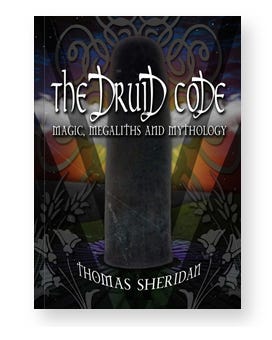
Thomas Sheridan’s book The Druid Code: Magic, Megaliths and Mythology (2016) presents an alternative interpretation of ancient Druidic practices, megalithic sites, and mythology, particularly in Ireland and Britain. The core arguments include:
Druids used magic and mythology as an early form of social psychoanalysis: Sheridan argues that Druids employed ritual magic, myths, and symbolism not merely as superstition or religion, but as a sophisticated psychological tool to process trauma, manage societal change, and influence human consciousness during periods of cultural upheaval.
Evolution of occult traditions: This Druidic system of magic and symbolism evolved over time, influencing later traditions such as folklore, witchcraft, and Freemasonry. Sheridan links Freemasons directly to Druidic descendants, citing historical figures like Thomas Paine, who described Freemasonry as an underground continuation of Druidism suppressed by Christianity.
Megalithic sites and folklore as a “bidirectional conduit” through time: By analyzing myths and stories attached to sacred sites (e.g., Irish megaliths like those on Knocknarea), the book proposes decoding a historical record of events around 2500 BC. This period marked a profound shift in human consciousness—possibly tied to proto-shamanic practices, lost Atlantic civilizations (with allusions to Atlantis), or traumatic global changes—that shaped modern human psychology and perception.
Greater historical influence of Druids: Druids and their legacy played a far more significant role in human development than mainstream history acknowledges, preserving archetypal knowledge through symbols that speak to the subconscious, bypassing rational language.
Critique of modern views and psychic/magical elements: Sheridan challenges the dismissal of ancient ancestors as primitive, emphasizing the power of symbolism and psychometry (e.g., sites “recording” events). He discusses concepts like generating “psychic charges” at megaliths and contrasts true magical understanding with pathological misuses (e.g., by “psychic vampires” or controlling elites).
The book blends archaeology, psychology (influenced by figures like Jung), esoterica, and personal exploration of Irish landscapes, suggesting a magical reawakening as a path forward amid modern crises. It is presented as speculative and revisionist, encouraging readers to rethink history “from Atlantis to alchemy.”
Fantastic book! So good I bought it twice.
This book is excellent and I am certain that the next generation of writers and thinkers on this subject will use Sheridans book as a standard reference manual in this area of study.